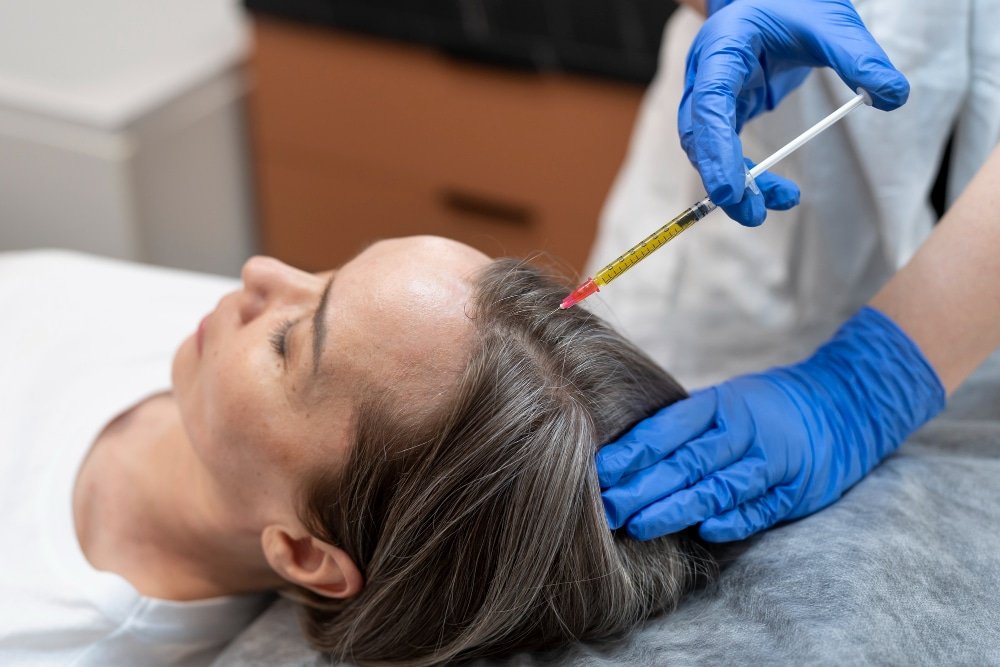

The scalp is mapped and numbed
The thinning areas are marked against the photographs from your assessment, and a topical anaesthetic is applied and left to work. This is the part that decides how comfortable the rest will be.

HAIR CLINIC · VICTORIA AESTHETIC & WELLNESS CLINIC · MAHÉ, SEYCHELLES
A small sample of your own blood, spun down to the one fraction that matters.
Platelet-rich plasma concentrates the platelets from your own blood — and with them the growth factors the body uses to repair itself — and places them where the follicle sits. At Victoria Aesthetics the session closes with LED laser over the treated scalp, and the course is three sessions four weeks apart.
COURSE3 sessions, 4 weeks apart
SESSION45 minutes, with LED laser
ANAESTHESIATopical, before the injections
RECOVERYImmediate
WHAT IT IS
Blood is roughly half red cells and half plasma, and floating in that plasma are the platelets. Platelets are not just for clotting: they carry the growth factors the body releases wherever tissue needs repairing. PRP is simply your blood, spun in a centrifuge until those platelets sit together in one narrow band, and that band — and only that band — is what goes back into your scalp.
So there is no product to be allergic to and nothing manufactured. The material is yours, drawn and used within the same forty-five minutes. What the treatment is trying to do is persuade follicles that are still cycling, but producing thinner and shorter hair each time, to go back to producing properly.
PRP works on follicles that still exist. It cannot bring back an area that has been completely bald for years, which is why the result depends so much on when you start.

WHAT HAPPENS IN THE TUBE
Scroll, and the tube separates as it does in the centrifuge. The heaviest fraction sinks, the lightest rises, and the platelets gather in the thin layer between them.
A 10 ml draw, spun for a few minutes at the bedside. Nothing leaves the room.
01 · THE DRAW
A small sample is taken from your arm, exactly as it would be for a blood test. At this point it is uniform: red cells, plasma and platelets all mixed together.
02 · THE SPIN
In the centrifuge the heaviest fraction settles at the bottom and stays there. Red cells are not part of the treatment — which is why what goes back into your scalp is straw-coloured, not red.
03 · THE BAND
Between the red cells and the clear plasma above sits a narrow layer where the platelets have gathered, concentrated well above their level in ordinary blood. This is the fraction that is drawn off and used.
04 · THE SESSION
A topical anaesthetic goes on first. The plasma is then placed across the thinning areas in a grid of small injections, and the session closes with LED laser over the treated scalp.
A TREATMENT OF PATIENCE
Which is why we photograph your scalp at the assessment, and why the honest conversation about whether this is working happens at six months rather than at six weeks.
THE COURSE
The shape is fixed; the detail is set at your assessment and reviewed as it goes.
WEEK 0
Scalp assessment
The pattern identified, anything else driving the loss ruled out, and the first set of standardised photographs taken.
WEEKS 0 · 4 · 8
Three sessions
Forty-five minutes each, four weeks apart. Plasma into the thinning areas, then LED laser over the treated scalp.
MONTH 3
The course closes
Less shedding is usually the first change anyone notices. Photographs are compared against the set from the assessment.
MONTHS 3–6
Density is judged
Six months is the first point at which density can be assessed rather than guessed, because that is how long the new hair needs to show.
ONGOING
Every 3 months
A maintenance session each quarter, at medical discretion, to hold what has been gained.
THE SESSION, UP CLOSE

The thinning areas are marked against the photographs from your assessment, and a topical anaesthetic is applied and left to work. This is the part that decides how comfortable the rest will be.
A small sample is taken from your arm and spun at the bedside. You stay in the room with it the whole time — nothing is sent anywhere, and nothing is kept.
The platelet-rich fraction is placed across the marked areas in a grid of small, shallow injections at the depth of the follicle. Most patients describe it as uncomfortable at moments rather than painful.
Light is delivered over the treated scalp to finish. Nothing is broken by this part and nothing is injected; it is the quiet end of the appointment, and you leave straight afterwards.
There is no downtime. Some tenderness, redness or mild swelling of the scalp for a few hours is common and settles on its own. Wash your hair normally from the following morning.
IS IT RIGHT FOR YOU
USUALLY A GOOD FIT WHEN
NOT THE RIGHT TREATMENT WHEN
WHY THE LASER IS IN THE SAME SESSION
Of the non-surgical options for pattern hair loss, platelet-rich plasma and low-level laser are the two with the longest research record. In the published comparisons PRP outperformed the common medical treatments — and the one thing it did not outperform was laser. So they are given together rather than sold separately.
Low level laser therapy for hairWHERE THE EVIDENCE STANDS
PRP is sold with a great deal of confidence. Here is the more careful version, because you are going to spend money on this.
Around 28 to 30 more hairs per square centimetre
That is the pooled figure from randomised trials in pattern hair loss, against a normal scalp density of roughly 160 to 250 hairs per square centimetre. A measurable gain, not a transformation.
Studied in randomised trials, with real limits
The trials are small, how the plasma is prepared varies from clinic to clinic, and most of them studied men. Reviewers describe the quality of the evidence as limited. We would rather you heard that from us.
What the comparisons do suggest is that PRP holds up well against the usual alternatives. In a network meta-analysis of forty randomised trials it came out ahead of minoxidil, finasteride, dutasteride and bimatoprost — and behind none of them except low-level laser, which is precisely why the two are given in the same session here.
What none of it supports is a promise. Responses vary from person to person, pattern hair loss continues underneath whatever is done to it, and nobody can tell you in advance which side of the average you will land on. What we can do is measure it properly and tell you the truth at six months.
WHY PATIENTS CHOOSE PRP
Your own material
Drawn from your blood and used within the same session, so compatibility is not a concern.
Non-surgical
No incisions, no theatre, no stitches — a course of appointments rather than an operation.
Reduces shedding
Stabilising the loss is often the first change noticed, and the most valuable one.
Improves hair calibre
Where there is a response, individual hairs tend to come back thicker, not only more numerous.
No downtime
Forty-five minutes, and you go back to your day the same afternoon.
Men and women
Used in both, with the plan built around the pattern rather than the sex.
Laser included
LED laser over the treated scalp is part of the session, not an extra line on the bill.
Combines well
With exosome mesotherapy, with medical treatment for hair loss, and before or after a transplant.
INVESTMENT
Every price below is for the full session — platelet-rich plasma and the LED laser that closes it. The scalp assessment comes first, because a course cannot be recommended before we have examined your scalp.
SCALP ASSESSMENT
SCR 900
Fully redeemable against your treatment. Includes the examination, the plan and the first set of photographs.
SINGLE SESSION · 45 MIN
SCR 5,200
PRP with LED laser therapy, in one appointment.
PACK OF 3 · THE FULL COURSE
SCR 13,200
SCR 4,400 a session — the recommended course of three, taken four weeks apart.
No consultation at Victoria Aesthetics is free. The assessment is charged because it is a medical examination, and it is credited in full against your treatment.
MEDICAL AUTHORITY
Victoria Aesthetic & Wellness Clinic · Hair clinic
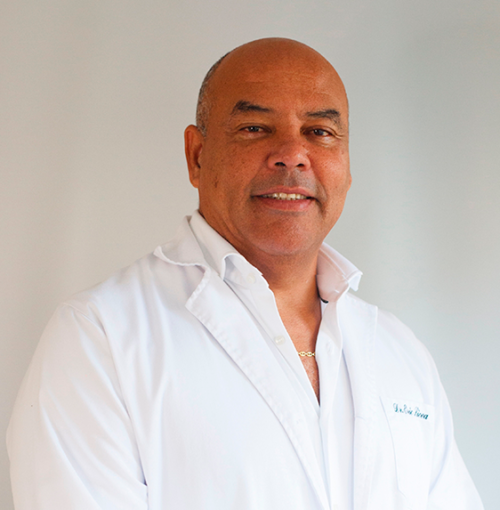
Dr. Licea examines the scalp, establishes the pattern of hair loss, draws and prepares the plasma, and performs the session himself. He also decides whether PRP is the right starting point for you, or whether something else is.
At Victoria Aesthetics we offer PRP hair restoration in Seychelles, and we will tell you at the assessment whether it is a reasonable option for your particular pattern of hair loss.
WHAT WE WILL NOT PROMISE
PRP influences hair loss. It does not end it, and nothing on this page will.
Responses vary between patients, and no treatment can restore a follicle that is no longer there. What we commit to is an assessment that tells you which kind of hair loss you have, a clear statement of whether PRP suits it and why, standardised photographs so that progress is measured rather than remembered, and a conversation at six months about whether continuing is worth your money.
QUESTIONS
PRP stands for platelet-rich plasma. A small sample of your own blood is drawn and spun in a centrifuge until the platelets gather in one narrow layer, and that fraction is placed into the thinning areas of the scalp. Nothing is manufactured and nothing is added.
Platelets carry the growth factors the body uses wherever tissue needs repairing. Concentrating them at the follicle is intended to encourage follicles that are still cycling towards the growing phase, so that the hair they produce is thicker and stays longer.
About forty-five minutes, from the draw to the laser at the end.
A course of three, four weeks apart. After that, a maintenance session every three months, at medical discretion — pattern hair loss continues underneath whatever is done to it, so maintenance is what holds the result.
No. LED laser over the treated scalp is part of the session and is included in the price.
A topical anaesthetic is applied to the scalp before the injections and left to work. Most patients describe the session as uncomfortable at moments rather than painful. No general anaesthetic is used and you are not sedated.
Gradually. Less shedding is usually the first thing noticed, around the third month. Density can be judged at about six months, because hair grows roughly a centimetre a month and there is no honest way to assess it sooner. No timeframe can be guaranteed for any individual.
What is gained can hold for a long time, but it is held by maintenance rather than by the first course. Pattern hair loss is a continuing process; without maintenance the gain is gradually lost again.
There is no downtime. Tenderness, redness or mild swelling of the scalp for a few hours is common and settles on its own. You can wash your hair normally the following morning and return to your usual activities the same day.
Because the material is your own, there is no question of an allergic reaction to it. Side effects are generally mild — tenderness, redness, bruising or short-lived swelling at the injection sites — and infection is uncommon. Your medical history is reviewed at the assessment, and anything that makes the treatment unsuitable is discussed then.
Patchy hair loss is a different condition from pattern hair loss, and the published evidence for PRP in it is much thinner. We will assess it case by case and tell you plainly what the evidence does and does not support before you commit to a course.
Yes. It is already given with LED laser in the same session, and it combines with exosome mesotherapy, with medical treatment for hair loss, and with a hair transplant before or after surgery where the surgeon considers it appropriate.
Yes, and female pattern hair loss is one of the commonest reasons it is asked for here. It is worth knowing that most of the published trials studied men, which is one of the limits of the evidence rather than a reason against the treatment.
The scalp assessment is SCR 900 and is fully redeemable against your treatment. A single session with LED laser is SCR 5,200, and the pack of three — the recommended course — is SCR 13,200, which works out at SCR 4,400 a session. Book online, send a WhatsApp message to +248 2511 268, or contact the clinic at Bel Etang Building, Hermitage Road, Mont Fleuri, Victoria, Mahé. Opening hours are Monday to Friday, 8:30 AM to 4:30 PM, and Saturday, 8:30 AM to 12:30 PM.
BEFORE YOU START A COURSE
This page is general information about treatments offered at Victoria Aesthetic & Wellness Clinic. It is not medical advice and does not replace an individual consultation. Results vary between patients and cannot be guaranteed.
THE FIRST STEP
The assessment tells you which kind of hair loss you have and whether this treatment suits it. If it does not, you will be told — and pointed at what does.
Bel Etang Building, Hermitage Road, Mont Fleuri, Victoria, Mahé, Seychelles.

Book a scalp assessment with Dr. Eric Licea, or take the online wellness assessment first if you would rather start from home.
Physician-led. Dr. Licea examines the scalp, prepares the plasma and performs the session himself.

Take our personalized assessment to find the perfect protocol for your goals.
CONTACT US
Your wellness journey is important to us. We believe in open communication and partnership with our patients. Share your experiences, ask questions, and let us know how we can best support you. We're always here to listen and provide the information you need.
You can make an appointment right now, or fill out the form and you'll receive an answer as soon as possible.
CLINIC ADDRESS
Bel Etang Building, Hermitage Road,
Mont Fleuri, Mahé, Seychelles
PHONE
+248 2 511 268
Call us+248 2 511 268
Talk with us (opens in a new tab)info@victoriaesthetic-wellness.com
Send an emailACCREDITATIONS & MEMBERSHIPS









VICTORIA AESTHETICS & WELLNESS CENTRE
International Standards. Island Luxury.
CLINIC HOURS
Monday–Friday: 8:30 AM – 4:30 PM
Saturday: 8:30 AM – 12:30 PM
General medical disclaimer: Educational content only — not medical advice, diagnosis, or a guarantee of individual outcomes. All treatments at Victoria Aesthetic & Wellness Clinic are offered under strict physician supervision, with individual assessment, informed consent, and documented follow-up.
© 2026 Victoria Aesthetics Wellness Centre. All rights reserved.
CONTACT US
Your wellness journey is important to us. We believe in open communication and partnership with our patients. Share your experiences, ask questions, and let us know how we can best support you. We're always here to listen and provide the information you need.
You can make an appointment right now, or fill out the form and you'll receive an answer as soon as possible.
CLINIC ADDRESS
Bel Etang Building, Hermitage Road,
Mont Fleuri, Mahé, Seychelles
PHONE
+248 2 511 268
Call us+248 2 511 268
Talk with us (opens in a new tab)seychellesaesthetics@gmail.com
Send an emailA 50% deposit confirms your appointment ·
ACCREDITATIONS & MEMBERSHIPS
VICTORIA AESTHETICS & WELLNESS CENTRE
International Standards. Island Luxury.
CLINIC HOURS
Monday–Friday: 8:30 AM – 4:30 PM
Saturday: 8:30 AM – 12:30 PM
General medical disclaimer: Educational content only — not medical advice, diagnosis, or a guarantee of individual outcomes. All treatments at Victoria Aesthetic & Wellness Clinic are offered under strict physician supervision, with individual assessment, informed consent, and documented follow-up.
© 2026 Victoria Aesthetics Wellness Centre. All rights reserved.
Website by
