GLUTEAL AUGMENTATION & CONTOURING · SEYCHELLES
Buttock augmentation Seychelles. Shape that holds its line.
Buttock augmentation Seychelles with Dr. Eric Licea: three medically distinct routes to fuller, higher, better-proportioned glutes — your own fat, a shaped implant, or collagen stimulated from within. Which one is right for you is decided by your anatomy, not by a trend.
- Subcutaneous-only fat grafting protocol
- Consultant anaesthesia and full intra-operative monitoring
- Surgical and non-surgical routes under one roof
ROUTESFat · Implant · Collagen
DOWNTIMEFrom none to 3 weeks
FIRST STEPAnatomical assessment, SCR 900
AT A GLANCE
Volume is only a third of the problem.
A buttock that reads as beautiful is not simply a bigger one. Three variables decide the result: volume (how much projection there is), shape (where that projection sits, and whether the upper pole and the lateral hollow are filled), and quality (skin tone, dimpling, and how the tissue behaves when you move).
Each of the three routes we offer is strong in a different column. Fat grafting reshapes the whole silhouette because it takes volume from where you do not want it. An implant delivers reliable central projection that does not depend on how much fat you have. Collagen stimulation firms and lifts without surgery at all. Choosing well is the entire consultation.

- Routes available
- Lipofilling · silicone implants · poly-L-lactic acid
- Anaesthesia
- Local, sedation or general, decided at assessment
- Results
- Immediate with fat and implants; from 6 weeks with collagen
- First step
- Anatomical and medical assessment, SCR 900
THREE ROUTES, ONE DECISION
Buttock augmentation Seychelles: pick the mechanism, not the marketing name.
Every clinic sells the same three procedures under different names. What actually differs is the material, the plane it sits in, and how long it lasts.
 SURGICAL
01
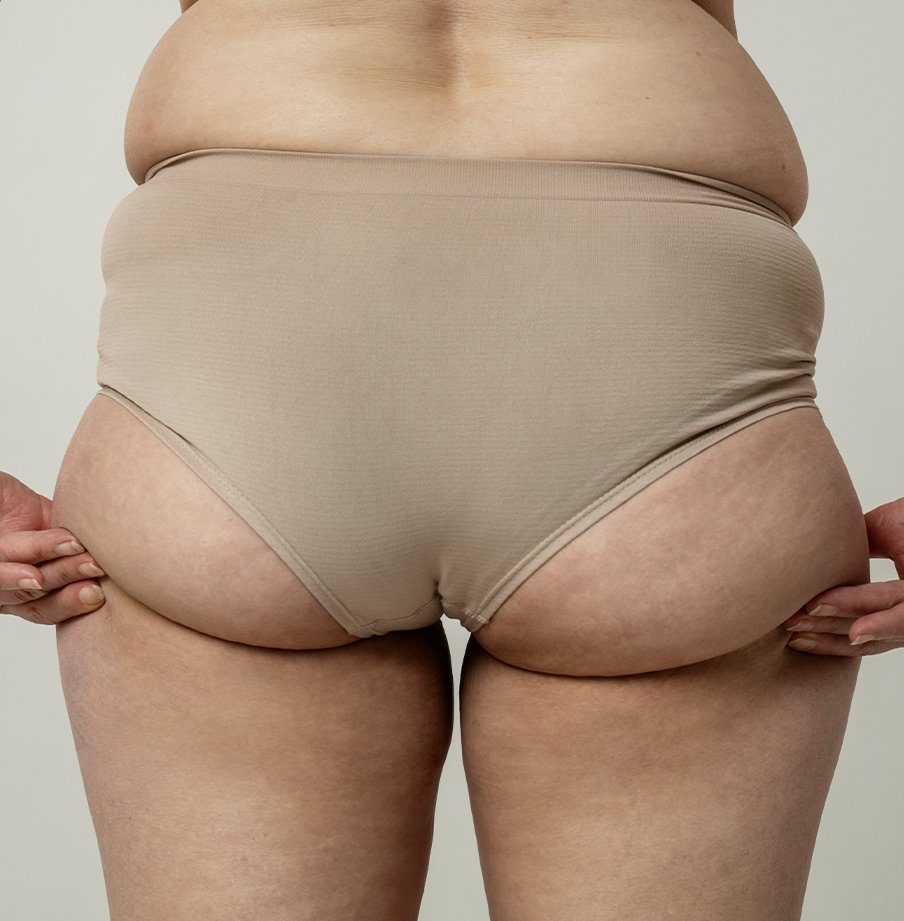
Lipofilling · your own fat
Fat is harvested by liposuction from the abdomen, flanks or thighs, purified, and re-injected into the buttock. You gain twice: the donor area is slimmed and the gluteal region is filled with living tissue.
- MATERIALAutologous fat, no foreign body
- LASTSLong term, once the graft has taken
- NEEDSEnough donor fat to harvest
 SURGICAL
02
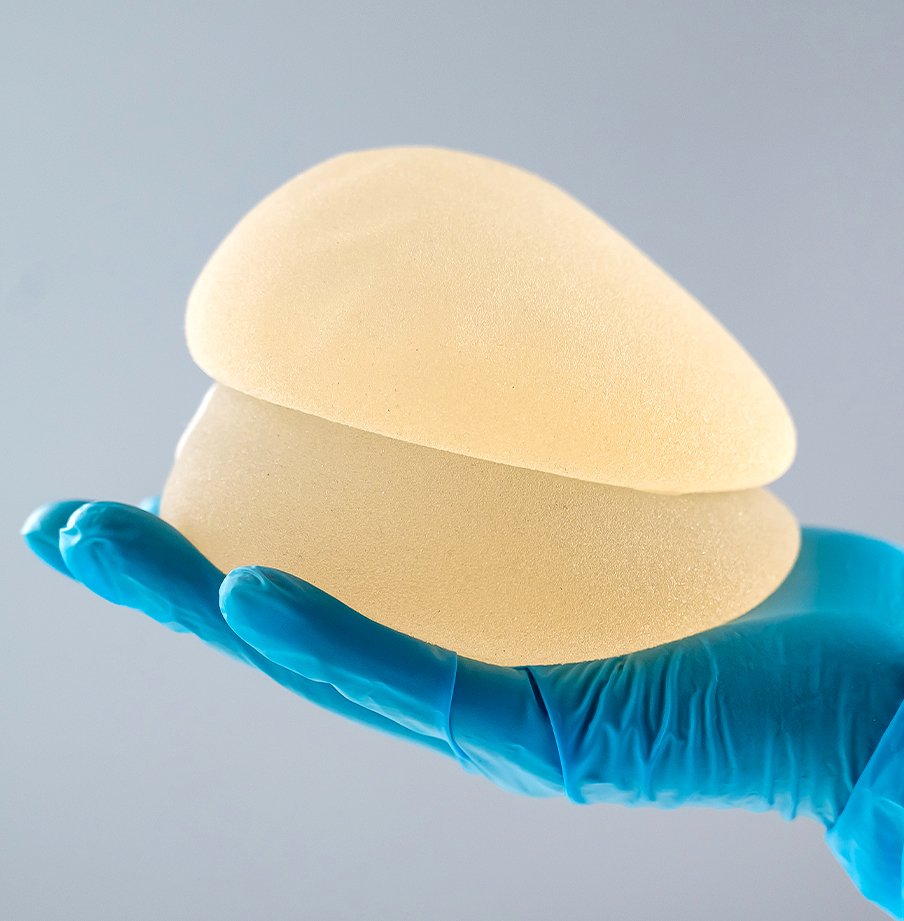
Implants · engineered projection
A shaped, solid or semi-solid silicone elastomer implant is placed through a single hidden incision in the intergluteal fold. Projection is chosen before you enter theatre and does not depend on your body fat.
- MATERIALSilicone elastomer, gluteal-specific
- LASTSYears; revision possible if needed
- NEEDSHealthy tissue cover over the pocket
 NON-SURGICAL
03
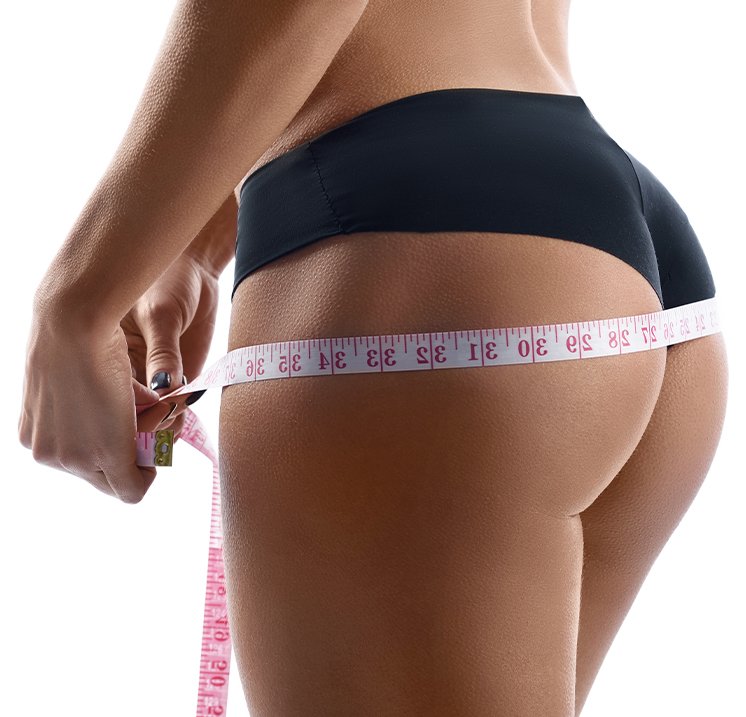
Collagen lift · poly-L-lactic acid
Injections of poly-L-lactic acid — the same biodegradable polymer used for decades in dissolvable sutures — prompt your own fibroblasts to lay down new collagen. Volume is not injected; it is grown.
- MATERIALPLLA · Lanluma® and Theraset®
- LASTSCommonly around two years
- NEEDSPatience — results build over months
These three routes are frequently combined. Liposuction of the waist and flanks with a modest collagen course, for example, often produces a more convincing silhouette than volume alone — and is the plan we recommend more often than patients expect. Where the concern is skin quality rather than volume, body Endolift for the buttocks starts at SCR 44,250.


Drag the divider, or use the arrow keys once it is focused.
BEFORE & AFTER
Read the waist, not just the curve.
When you compare the two halves of this image, the change that does the most work is not the projection of the buttock. It is the line above it. Narrowing the waist and filling the lateral hollow is what turns added volume into proportion.
- 1Upper pole filled, so the buttock starts higher on the back.
- 2Lateral depression softened, removing the square outline.
- 3Waist and flank reduced, which exaggerates the curve without adding a millilitre to it.
Individual results vary with anatomy, graft survival, weight stability and aftercare. Photographs are illustrative and are not a promise of outcome.
ROUTE 01 · LIPOFILLING / FAT GRAFTING
Your own tissue, moved to where it belongs.
Fat is aspirated under low negative pressure from the areas you would rather not have it — usually the abdomen, flanks, lower back or inner thighs — then decanted and purified so that what is re-injected is viable adipose tissue rather than oil and fluid. It is placed into the gluteal region in fine, layered passes, because grafted fat survives only where it can pick up a new blood supply.
Not all of it stays. A proportion of the graft is reabsorbed over the first three months, which is why we plan for a stable weight, deliberately place more than the final target, and review you at three months before deciding whether a second session adds anything.
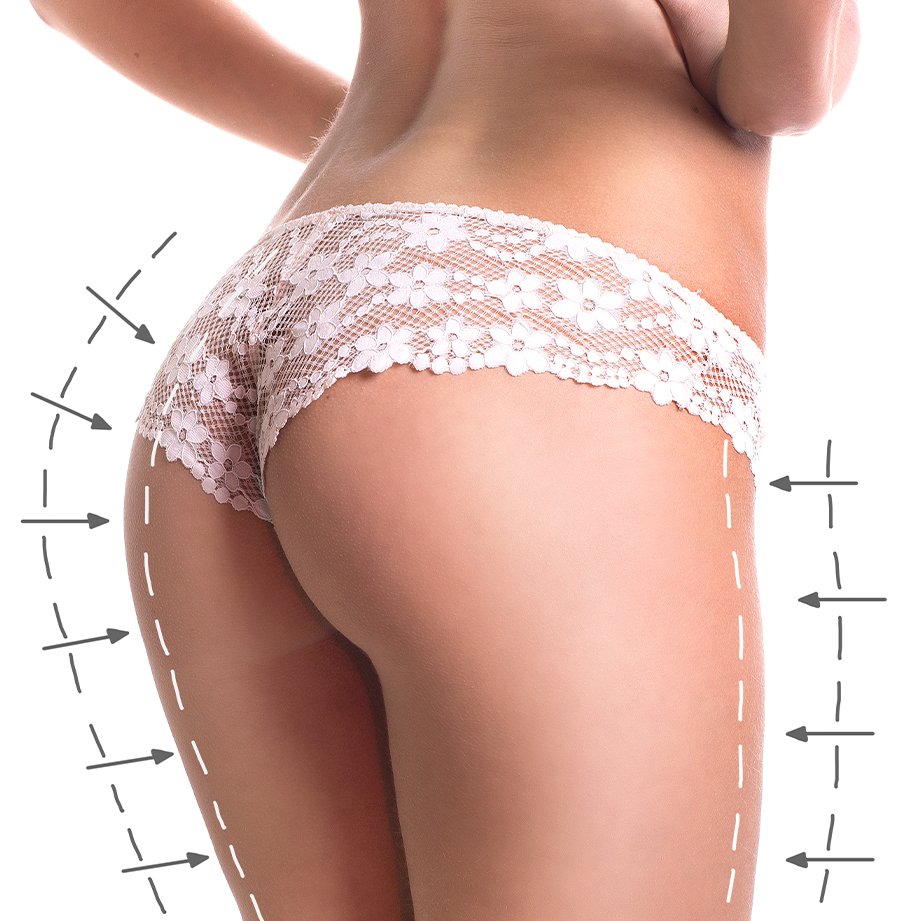
Two areas treated at onceDonor site slimmed, gluteal region filled
Subcutaneous plane onlyNever into or beneath the gluteal muscle
Reviewed at three monthsOnce reabsorption has settled
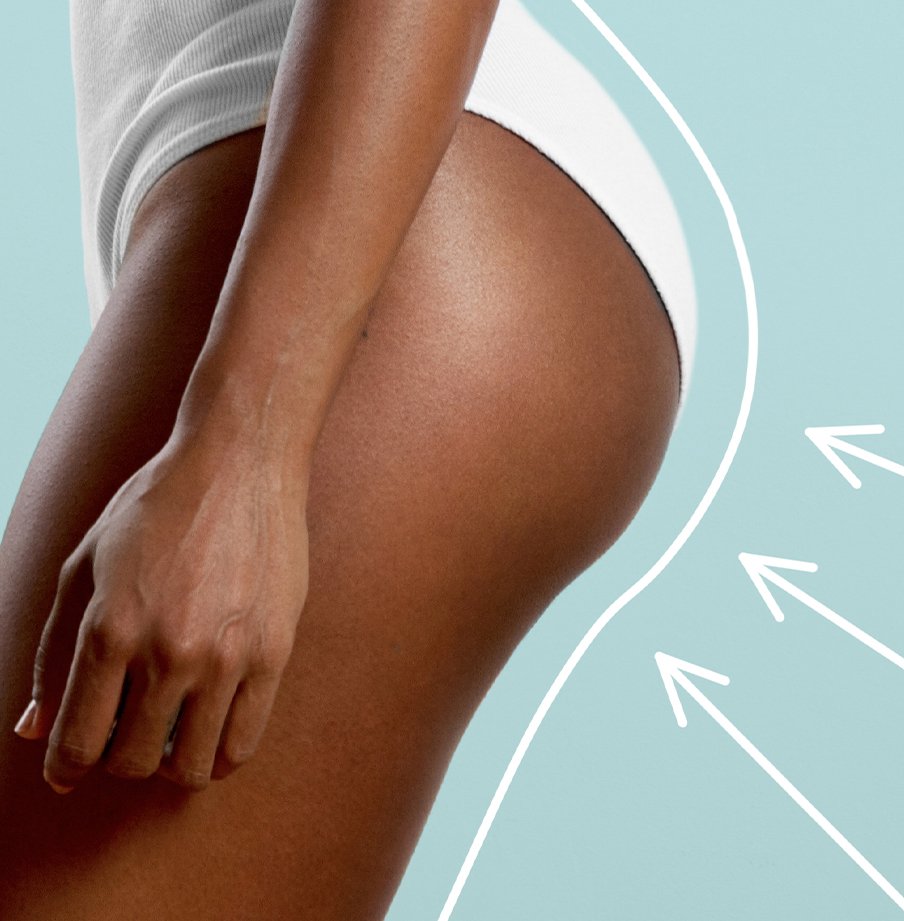

THE NON-NEGOTIABLE
One plane. That is the whole safety story.
Gluteal fat grafting is the one aesthetic operation where technique is not a matter of taste. The depth at which fat is placed is the difference between a routine recovery and a catastrophic one. Read the BAAPS gluteal lipofilling safety recommendations (opens in a new tab).
- Skin and dermis
The surface. Nothing is deposited here.
- Subcutaneous fat — the only target
Every millilitre of graft is deposited in this layer, above the fascia, in thin fanned passes so each parcel of fat sits close to a blood supply.
- Gluteal fascia
The hard stop. The cannula stays superficial to it for the entire case.
- Gluteus maximus and below
Never injected. The large gluteal veins run within and beneath the muscle; fat forced into a torn vein can travel to the heart and lungs. Reviews of fatalities worldwide found fat in the muscle or deeper in every case — and in none where it stayed subcutaneous.
Subcutaneous only
The cannula never crosses the fascia. If the volume you want cannot be achieved safely in that layer, we stage it or change route — we do not go deeper.
Angled away from the deep plane
The cannula is kept parallel to the skin surface, with the tip visible and controlled, rather than angled downward toward the vessels.
Blunt, large-bore cannulas
Blunt-tipped instruments of adequate diameter are used to inject. Fine sharp needles are not appropriate for gluteal grafting.
Ultrasound to confirm the layer
International societies now support real-time imaging to document that the cannula tip is where the surgeon believes it is. We follow that standard.
Volume decided by anatomy
Graft volume is limited by what the subcutaneous layer can hold without excessive pressure — not by the size a patient arrives asking for.
Anaesthesia consultant in theatre
Continuous monitoring throughout, with an anaesthesiologist whose only job in the room is you, and immediate recognition protocols if anything changes.
If you are comparing clinics — here or abroad — ask each one a single question: in which anatomical plane is the fat placed, and how is that verified? The answer tells you almost everything.
INSIDE THE PROCEDURE
Volume that moves like tissue, because it is tissue.
See how the assessment worksROUTE 02 · BUTTOCK AUGMENTATION WITH IMPLANTS
When there is no fat to move.
Slim, athletic and post-weight-loss patients are often told they are not candidates for augmentation. They usually are — just not with fat.
Gluteal implants are not repurposed breast implants. They are denser, less compressible devices made of solid or semi-solid silicone elastomer, engineered to tolerate sitting, walking and exercise, and shaped specifically for the gluteal region. Size and projection are selected against your measurements before the day of surgery.
Access is through a single incision hidden within the intergluteal fold, so there is no visible scar on the buttock itself. The operation is usually performed under general or regional anaesthesia and takes roughly an hour and a half. Sitting is restricted in the early phase, and a compression garment is worn while the pocket settles.
Implants deliver predictable central projection that does not shrink over the following months and does not depend on body weight. Their trade-off is that they are a foreign body: the recognised risks include seroma, infection, wound healing problems at the fold, capsular contracture and implant malposition. All of them are discussed in full, with their real frequencies, before you consent.
Discuss implant sizing (WhatsApp, opens in a new tab)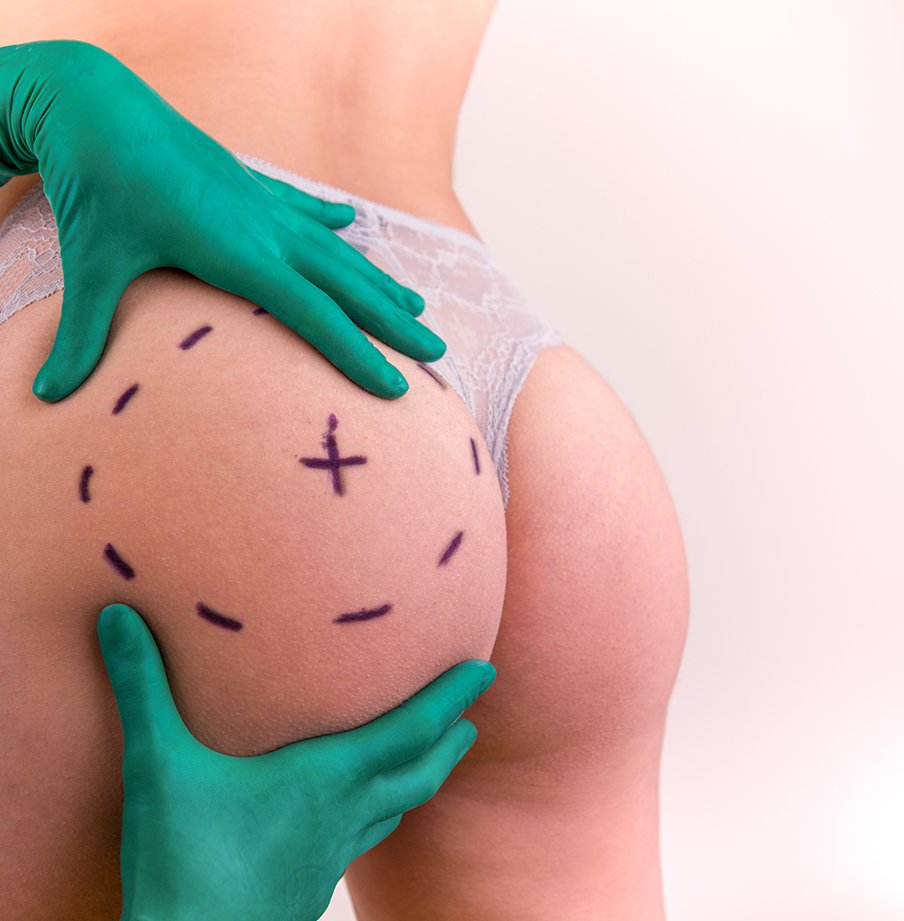
Subfascial
The pocket is made beneath the gluteal fascia but above the muscle. Reported in the literature to give good lower-pole fullness, with less muscular discomfort in recovery.
Intramuscular
The implant sits within the substance of gluteus maximus, giving thick tissue cover and a well-disguised edge. The dissection must respect a precise plane to remain safe.
Submuscular
Beneath the muscle entirely — maximum coverage and a seamless transition from the lower back, used selectively where soft tissue is thin.
Subcutaneous placement — directly under the skin — is not used for cosmetic gluteal implants, because the device becomes visible and prone to displacement. Which of the three planes above suits you is a surgical judgement made on your tissue thickness and the shape you are asking for.
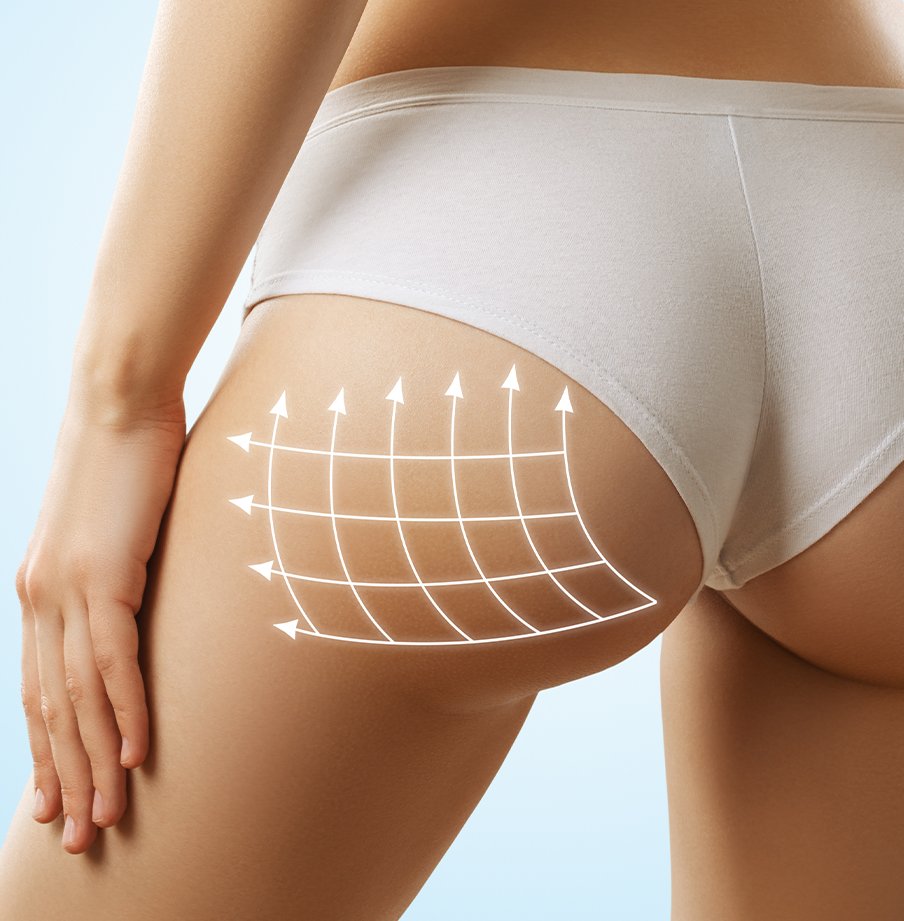

ROUTE 03 · NON-SURGICAL COLLAGEN-STIMULATING LIFT
Volume you grow, not volume you insert.
No theatre · no scars · no time off

Poly-L-lactic acid injections, performed in the clinic in under an hour.
Poly-L-lactic acid is a synthetic, biodegradable polymer with a long medical history — the same family of material used in absorbable surgical sutures. Injected into the deep dermis and subcutaneous layer of the buttock, the microparticles provoke a controlled fibroblast response. Over the following weeks your own collagen is laid down around them, and the particles themselves are absorbed and gone.
That mechanism explains everything patients find surprising about this treatment. The fullness you see on day one is swelling from the diluent, not the result — it settles within days. The real change appears from about three to four weeks and continues building for three months. And because what is holding the shape is your own collagen rather than a gel, the effect is firm and natural rather than obviously filled.
It is delivered as a short course rather than a single visit — typically two to four sessions spaced several weeks apart, the number decided by your starting point and your goal. At our clinic the collagen stimulators used for body work are Lanluma® and Theraset®.
- Session length
- Approximately 30 to 60 minutes
- Anaesthesia
- Topical or local; no sedation required
- Course
- Usually 2 to 4 sessions, several weeks apart
- Result appears
- From weeks 3 to 4, maximal around month 3
- Duration
- Commonly around two years, with top-ups
- Downtime
- None; mild swelling or bruising for a few days
DAY 0 TO 2
Temporary fullness
What you see immediately is fluid and swelling, not the treatment working. Massage as instructed and expect it to subside.
WEEK 3 TO 4
Collagen begins
Fibroblast activity produces the first genuine gain in volume and firmness. This is the point at which most patients stop worrying.
WEEK 6 TO 12
Shape becomes visible
Contour rounds out, the upper pole lifts, and skin texture and dimpling typically improve alongside the volume.
MONTH 3 ONWARD
Peak and maintenance
Results reach maximum and are reviewed. A maintenance session keeps the collagen gain in place as it slowly turns over.
Timings are typical, not guaranteed; age, skin quality and lifestyle all shift the curve.
SIDE BY SIDE
Which route fits which body.
A candid comparison, including the parts that are inconvenient for us to mention.
| CRITERION | Lipofilling | Implants | Collagen lift (PLLA) |
|---|---|---|---|
| MATERIAL | Your own purified fat | Silicone elastomer device | Poly-L-lactic acid, then your own collagen |
| SURGERY | Yes — liposuction and grafting | Yes — pocket dissection, single incision | No — injections only |
| ANAESTHESIA | Sedation or general | General or regional | Topical or local |
| RESULT VISIBLE | Immediately, then settles over 3 months | Immediately, once swelling resolves | Gradually, from weeks 3 to 4 |
| SHAPES THE WAIST TOO | Yes — this is its main advantage | No, unless liposuction is added | No |
| NEEDS DONOR FAT | Yes, and a reasonable amount of it | No | No |
| DOWNTIME | Around 2 to 3 weeks off normal routine | Around 2 to 3 weeks, sitting restricted | None |
| DURABILITY | Long term for the fat that survives | Years; revision or exchange possible | Commonly around two years |
| MAIN RISKS TO WEIGH | Partial reabsorption, contour irregularity, and — if technique is wrong — fat embolism | Seroma, infection, wound problems at the fold, capsular contracture, malposition | Nodules or lumps, bruising, swelling, asymmetry; under-correction if the course is stopped early |
| TYPICALLY SUITS | Patients with donor fat who also want a narrower waist | Slim or post-weight-loss patients wanting reliable projection | Patients wanting firmness and a modest lift with no downtime |
Scroll the table sideways on a phone. Every risk listed here is discussed individually, with its relevance to your own health profile, at the assessment. Fees are quoted in writing after that assessment, because they depend on volume, theatre time and anaesthesia.
HONEST SCREENING
Who we will treat, and who we will not.
Turning people away is part of doing this properly. If you are not a candidate today, we will tell you what would make you one.
USUALLY A GOOD CANDIDATE
- In good general health, with any chronic condition well controlled.
- A stable weight for at least six months, and no plan for major weight change.
- A non-smoker, or willing to stop well before and after surgery.
- Clear about what bothers you — projection, upper-pole flatness, lateral hollow, skin laxity — rather than working from a photograph of someone else.
- Able to protect the result: restricted sitting, compression garment, and follow-up attendance.
WE WILL DELAY OR DECLINE
- Pregnancy or breastfeeding.
- Active infection in the area, or uncontrolled diabetes or immunosuppression.
- Bleeding disorders, or anticoagulation that cannot safely be paused.
- A history of venous thromboembolism without proper risk assessment and prophylaxis.
- Requests for a volume that cannot be placed safely in the subcutaneous plane. We will offer a staged plan instead — never a deeper injection.
- Expectations that no operation could meet, or a decision being made under pressure from someone else.
YOUR PATHWAY
From first question to final review.
Five stages. You can stop at any of them, and the assessment fee is deductible from whichever route you choose.
01
Anatomical and medical assessment · SCR 900
Measurements, tissue thickness, skin quality, donor-site availability, and a full medical and medication history. We photograph with standard lighting and angles so that any later comparison is honest.
02
The plan, in writing
Route or combination of routes, realistic volume, anaesthesia, theatre time, recovery demands and total fee. You take it away and read it without anyone in the room.
03
Pre-operative workup
Bloods and any screening your history requires, thromboembolism risk scoring and prophylaxis, and a pre-anaesthetic review with the consultant who will be with you in theatre.
04
Procedure day
Markings taken standing, sterile field, continuous monitoring, warming and pressure-point protection. Discharge only when the recovery criteria are met, with written instructions and a direct contact number.
05
Recovery and review
Scheduled reviews through the first three months, with standardised photography repeated at the end. Only then do we discuss whether a second stage would add anything worth having.
AFTERCARE
The result is made in the first month.
Grafted fat needs an undisturbed blood supply and an implant pocket needs to settle without shear. Both mean the same thing: pressure on the buttock is the enemy for the first few weeks. Patients who follow the sitting protocol keep noticeably more of their result than those who do not.
FIRST 2 TO 3 WEEKS
- No direct sitting on the buttocks; use the cushion provided, and sit on the back of the thighs.
- Sleep on your front or side.
- Compression garment worn as instructed, day and night.
- Walk gently and often from day one — it is the best thromboembolism prophylaxis there is.
- No driving while restricted sitting applies, and none while on strong analgesia.
- Keep every wound review appointment, even if everything feels fine.
WEEK 4 TO MONTH 3
- Sitting normalised progressively, on our instruction rather than by feel.
- Gym and impact exercise reintroduced in stages; no heavy glute loading until cleared.
- Hold your weight steady — grafted fat behaves like the rest of your fat, gaining and losing with you.
- Swelling and firmness settle gradually; do not judge the result before the three-month review.
- Scar care at the fold, and sun protection on any exposed donor-site scars.
- Call us — do not wait for the next appointment — for fever, spreading redness, increasing pain, breathlessness or calf pain.
WHY THIS CLINIC
The safest part of your operation should be the part nobody advertises.
- A consultant anaesthesiologist, not a monitorPre-anaesthetic assessment, a tailored plan, and one clinician whose entire role during your procedure is your physiology.
- Thromboembolism risk taken seriouslyFormal risk scoring, mechanical and pharmacological prophylaxis where indicated, and early mobilisation built into the plan.
- Postoperative pain managed properlyMultimodal analgesia planned in advance, because pain that stops you moving is a safety problem, not just a comfort one.
- Recovery-criteria dischargeYou go home when objective criteria are met — never because the list is finished.

Dr. Eric Licea Surgeon · Victoria Aesthetics
WHO WILL OPERATE
You meet your surgeon before you decide, not on the day.
Buttock augmentation Seychelles patients are assessed, planned and operated on by Dr. Eric Licea. The clinician who examines you at the assessment is the one who marks you standing on the morning of surgery and the one who reviews you through the first three months. There is no handover to a name you have never met.
He works alongside a consultant anaesthesiologist who assesses you before the procedure and monitors you throughout it — the arrangement described below, and the reason surgical dates here are planned around two diaries rather than one.
Book my assessment with Dr. Licea (opens in a new tab)The operation I decline is as important to the result of this clinic as the one I perform.
Dr. Eric Licea
QUESTIONS
Frequently asked questions.
Who performs buttock augmentation Seychelles procedures at Victoria Aesthetic?
Every route, lipofilling, implants or the collagen lift, is assessed, planned and performed by Dr. Eric Licea at our clinic in Mont Fleuri, Mahé, with a consultant anaesthesiologist monitoring every surgical procedure.
Is a fat-transfer buttock augmentation safe?
It is safe when one rule is respected absolutely: the fat goes into the subcutaneous layer and never into or beneath the gluteal muscle. Worldwide reviews of deaths from this operation found deep or intramuscular fat in every case examined and none where the graft stayed subcutaneous. Since international societies issued that guidance, and since ultrasound has been used to confirm the layer in real time, reported outcomes have improved substantially. We work to that standard, with a consultant anaesthesiologist monitoring you throughout.
How much of the transferred fat actually stays?
Not all of it. A proportion is reabsorbed over the first three months, which is why we plan for slight over-correction, ask you to keep your weight stable, and do not assess the result until the three-month review. The fat that survives has established its own blood supply and behaves like the rest of your body fat from then on — including gaining and losing with you.
Can I have augmentation if I am very slim?
Usually yes, but not with your own fat, because there may be too little to harvest. Slim and post-weight-loss patients are typically better served by an implant, which delivers projection independently of body fat, or by a collagen-stimulating course where the goal is firmness and a modest lift rather than a large volume change.
How soon can I sit down normally?
Expect two to three weeks of modified sitting — on the back of the thighs or on the cushion we provide — then a staged return on our instruction. This is the single instruction that most affects how much of your result you keep, and it is the one patients most often try to shortcut.
Why does the non-surgical treatment take months to show?
Because nothing is being filled. Poly-L-lactic acid does not add volume itself; it triggers your fibroblasts to build new collagen, and that takes time. The fullness on the day is swelling from the diluent and settles within days. Genuine change starts at around three to four weeks and continues to about three months. Most patients need two to four sessions several weeks apart, and the effect commonly lasts around two years.
Will there be a visible scar?
With fat grafting, access is through small cannula entry points that fade to near-invisibility. With implants, the incision is placed within the intergluteal fold, so there is no scar on the buttock itself. Donor-site liposuction leaves a small number of short marks in concealed positions. All of them are shown to you on a diagram before you consent.
Can the routes be combined?
Frequently, and often to better effect than any one alone. Liposuction of the waist and flanks combined with a modest graft changes the silhouette more convincingly than a large graft on its own. Implants can be combined with fat grafting to soften the transitions. A collagen course can refine skin quality after either.
What does it cost?
For buttock augmentation Seychelles patients, the assessment is SCR 900 and is deductible from your treatment. Beyond that we quote in writing after the assessment, because the fee depends on the route, the volume, theatre time and the type of anaesthesia. We would rather give you an accurate figure once than an attractive one now.
Confidential · physician-led · the assessment fee is deductible from your treatment.
FLEXIBLE DELIVERY OPTIONS
Wherever you need us.
Clinic · villa · online

AT THE CLINIC
Bel Etang Building, Mont Fleuri
Surgical and injectable gluteal work is performed here, with the full equipment and the full team behind it.
Book at the clinic (opens in a new tab)
IN-HOME AFTERCARE
Your villa or your yacht
Dressing checks and recovery reviews brought to you in absolute privacy, under the same clinical standards.
Ask on WhatsApp (opens in a new tab)
ONLINE CONSULTATION
Encrypted telehealth review
Discuss suitability and see the plan before you travel, from wherever you are.
Ask on WhatsApp (opens in a new tab)THE SCR 500 NETWORK ADVANTAGE
Introduce someone to the clinic.
When they complete their first treatment with us, SCR 500 is added to your clinic profile, ready for your next session.
Credentials
- Licensed by the Seychelles Medical & Dental Council
- Subcutaneous-only gluteal fat grafting protocol
- Consultant anaesthesia and continuous monitoring
- Standardised photography at baseline and review
- Your medical data kept confidential and secure
BEFORE ANY DECISION IS MADE
Start with the assessment, not the procedure.
Measurements, tissue thickness, donor-site availability and your medical history decide which of the three routes is appropriate — and whether any of them is. You leave with a written plan, a written quotation, and no obligation.
Our commitment. If the clinical assessment shows that no route is safe or suitable for you, we say so plainly, the reasons are explained in writing, and we guide you toward a safer alternative at no further cost.
Surgical dates are planned around theatre and anaesthesia availability. Assessment slots open weekly.
Your Journey to Optimal Health Begins with a Single Step
Not sure where to start? Book a complimentary 15-minute discovery call or take our personalized assessment to find the perfect protocol for your goals.
Book Your Initial Consultation (SCR 900)
100% Confidential. Physician-Led. Fully deductible from your treatment plan.
Take the Free Wellness Assessment Quiz
Take our personalized assessment to find the perfect protocol for your goals.